The person whose Saints day we remember today (on March 1st) Dewi (in English St. David) is almost completely unknown. We don’t know his date of birth and the date of his death 588 places his life squarely in the period we call the Dark Ages. Or we used to call dark ages, we are beginning to understand that the period between the End of the Roman Empire and the beginning of the Norman Empire were anything but benighted, in fact they were a period of extraordinary intellectual and religious development … with art works and theologies that show people who dealt in complex and fascinating cultures…
The ancient Celtic church which flourished in this time has been a problem for historians because it doesn’t fit the familiar narrative that St Augustine brought Christianity to Britain as a missionary to the Pagan Saxons.
Dewi and Padraig, or David and Patrick, are both Saints who came out of a monastic academy in South Wales called Llanilltyd after St Illtyd who is thought to have founded it.
And St Illtyd was one of the British Christians whose Christianity can be traced back to the conversion of the Roman Empire under the British born Emperor Constantine. As Christianity spread throughout the Roman Empire it came to Britain. When the Romans withdrew in around 400 they left behind many legacies as we know including the villas and baths that in popular histories fell into dis-use but also including a fledgling Christianity which thrived. And one of these Christian communities eventually became a centre of education which spawned dozens, if not hundreds of ‘Saints’, holy people, men and women, who preached, taught, healed and left in their trail; hermitages, wells and shrines, evidence of their pilgrim trail throughout Britain and the island of Ireland.
Dewi’s mother was called Non, a Welsh name which is a version of Anna – traditionally also the name of the Mother of Mary – so there is a little story being quietly told here of a Biblical tradition. It only occurred to me that in Welsh the name David, Dewi sounds very much more like the Hebrew or Arabic original Dawid or Daowd…
This ancient tradition then, developed far away from the austerities of the Church Fathers and instead took on the distinctive characteristics of the host island. It is recognisable from the intricate knot work that perhaps represents the experience of complexity and entanglement with nature: this was a spirituality which was connected to and emergent from the land; not an imposed colonisation or missionary conversion but a religion which found resonance in the breathing of the people and the movement of their land.
These Celtic Saints emerged at a time when there could have been little or no hierarchy, orthodoxy or creed, so they learned from and grew with the indigenous culture they dwelt in and which in turn thrived within the Christianity they preached.
There is every reason to suppose that the hero of their Gospel: a poetic storyteller who sided with the outcast and was murdered as an outlaw by the authorities, would have immediately appealed to the people they encountered, and likewise there is every reason to suppose that the indigenous culture also gifted back to the Christian story various elements that were congruent with the mystical gospels and scriptures which the saints such as Dewi preached.
John O Donohue writes (in Anam Cara and Benedictions) about the Celtic sensitivity to the ways of nature and the capacity to work within the energy of the natural world, he says that every time his father left the house he would turn around to “breathe a full explicit breath… he inhaled the spirit of his loved ones to nourish and protect his journey…” (from Benedictions, p. ) Such a sensibility, which envisions complexity and entanglement within natural systems as a blessing, and sees the ways of nature as infused with divine presence, may give a clue to what seems to be the only remaining fragment of Dewi’s own theology… he is associated with the saying: ‘Gwnewch y pethau Bychan’: attend to the little things, which co-incidentally is also the spirit in which our New Year’s services commenced as I sought ways to emphasise the small and slow, and ways to start close in…
So for all these reasons I think Celtic spirituality still has relevance for Unitarians, a spirituality that is un-orthodox, but based on practice, non-creedal, earth-centred and recognising kindness as part of the implicit flow of a life interfused with divinity, that between each human being is an act of kindness, like the flow of breath that is shared between us as we sit attentive to the weaving of blessing…
But there is another reason I wanted to focus this morning on the story of Dewi Sant. When we considered the story of St Bridget, the Irish saint, on her day at the start of February – do you remember the story of her flowing cape and how she outsmarted the power of the warlord? How this obviously mythological story is a powerful reminder that such stories are not intended to be read as accurate history, but more as part of an inheritance; a way of transmitting wisdom through time, that when we hear a story in its richness we may understand a hidden texture of clarity – in Bridget’s case her cloak represented her widening influence – and using this same hermeneutic or interpretive key may help us unlock something more about that memory of David too.
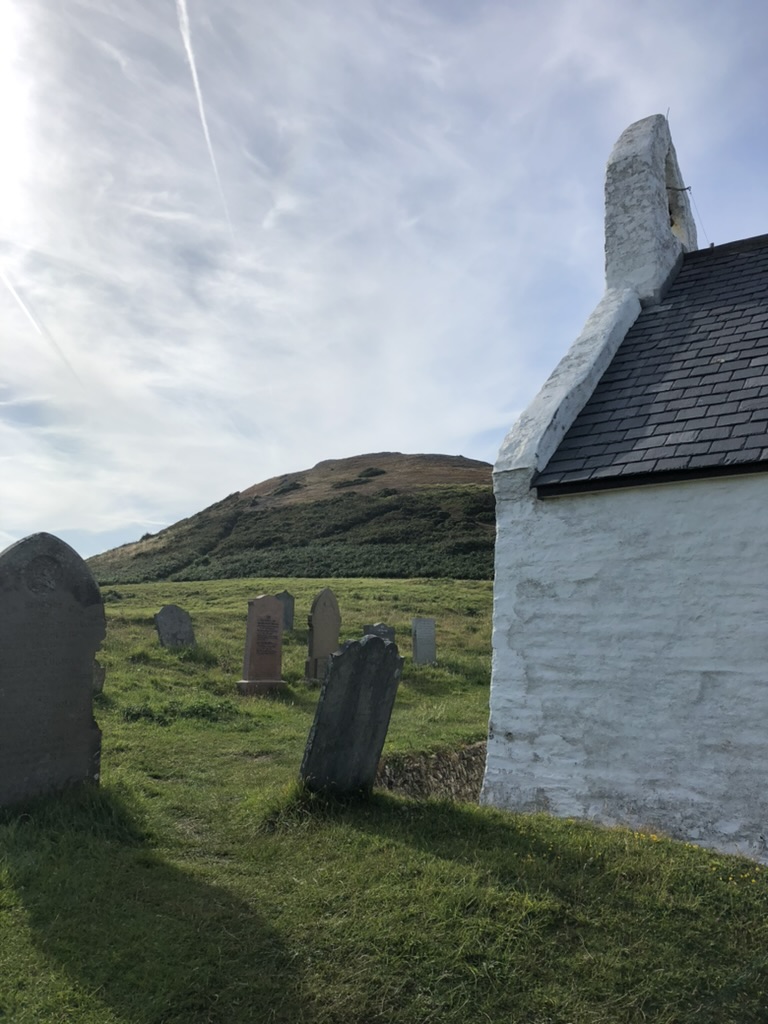
[pictured is the ancient egwlys y Mwnt in Cerdigion]
My brother recently visited St David’s the little Cathedral town in Ceredigion and when we spoke we laughed about the famous little story of a hill rising up for Dewi to be heard. My brother pointed out that the little town is in a little dip and no little hill is to be seen, but of course that misses the point of the story… its not a literal history but a poetic metaphor: In the story, all the Bishops were anxious to be heard over the common people and so according to the tale they began making a pile of garments on which to stand, we can imagine Bishops with glorious gowns and mitres, all the excessive trappings of church power and pomp, but Dewi humbly laid down ‘a small cloth’ could this have been his own cloak? and the earth rose up to amplify his voice, a dove flew down to emphasise his wisdom… what we are being shown in this story a man who worked with the elemental forces of nature, instead of the hierarchal power of Church orthodoxy, the little story can be read as a metaphor for Celtic Christianity and although it may be almost all we know of Dewi Sant it carries a very significant message: spiritual power is a blessing that flows and is emergent, not a power that stands on garments of grandeur, not the power of pomp or majesty, but the gentle breathing of a parent at daybreak, not domination, but the little things… y pethau bychan…
 A Space of possibility
Leave a comment