It is a feature of our society that we are goal oriented: we value results and judge a thing by its outcome.
The philosopher and psychiatrist Dr. Iain McGilchrist has been researching and writing over many years on the ‘two hemispheres’ theory of neurology which seeks to understand the human brain in relation to the curious fact that each of the two hemispheres of the brain seem to have different specialities. This theory was popular in the 70’s but as it was popularised it was oversimplified and McGilchrist points out (in a brilliantly animated lecture here) that it isn’t true to say that one hemisphere does emotion and the other does logic, it is really much more complex, both hemispheres are involved in emotion and language, logic and analysis. A different way of understanding is to see that one hemisphere seems to accomplish a ‘wide awareness’ and is connected to wisdom and intuitive ways of knowing and the other seems equipped to grasp facts swiftly and effectively. So of course we need both. McGilchrist uses the metaphor of a bird that needs to focus precisely on details so it can distinguish between the gravel and the seed while also being constantly widely aware of all the predators in the airspace and local bushes.
We need to balance both hemispheres and their respective ways of knowing but it is important to note that one hemisphere seeks to dominate the other; the left with its determination to grasp details and facts seeks to be dominant and even cancels out its own awareness of the operation of the right hemisphere. According to McGilchrist the reason why the dominant left brain doesn’t understand the intuitive and the numinous is that it doesn’t, won’t, recognise that the right brain is even there. It ‘cancels’ it in its determination to maintain dominance. That is why, he says, propositional ways of knowing become so frustrated by ways of knowing that demand intuition wideness, largess. And we can see the debate between atheists and religious people playing out in exactly that way. To our loss, no doubt because we need both. We need the hemispheres to be in balance if we are to be effective in confronting the exceptional challenges that face us in society today; ecological catastrophe, biological reality.
It is left brain dominance that ensures that we stay trapped in goal based/ outcome fixated reality, and in that world view we increasingly judge according to strategic outcomes; data drives our ability to evaluate every and anything, and evaluation remains at the centre of our understanding. They say if the only tool you have is a ruler then you will tend to make measurements – and this idea seems to scale up almost infinitely to encapsulate our whole western culture.
This is why we have become largely and almost completely dislocated from the Holy, the sacred, the Divine. Being unmeasurable allows the dominant left brain to conclude that Deity is non-existent.
Invisible, the eternal immortal slips quietly from view …
And it is why we harshly judge lives on their achievements, on spiked metrics of success; visibility, publications, celebrity, performance, the outward and remaining shell, the remnants and traces of lived experience.
As a parent I keep hearing the phrase ‘making memories’ and it makes me want to scream. I don’t do things in my family for this predicted outcome of memory, but for the experience of living in the now…
This is (slowly) working its way back around to Michael; because I want to say that I resist very strongly any account of any life that tries to judge it on outcomes or by perceived achievement.
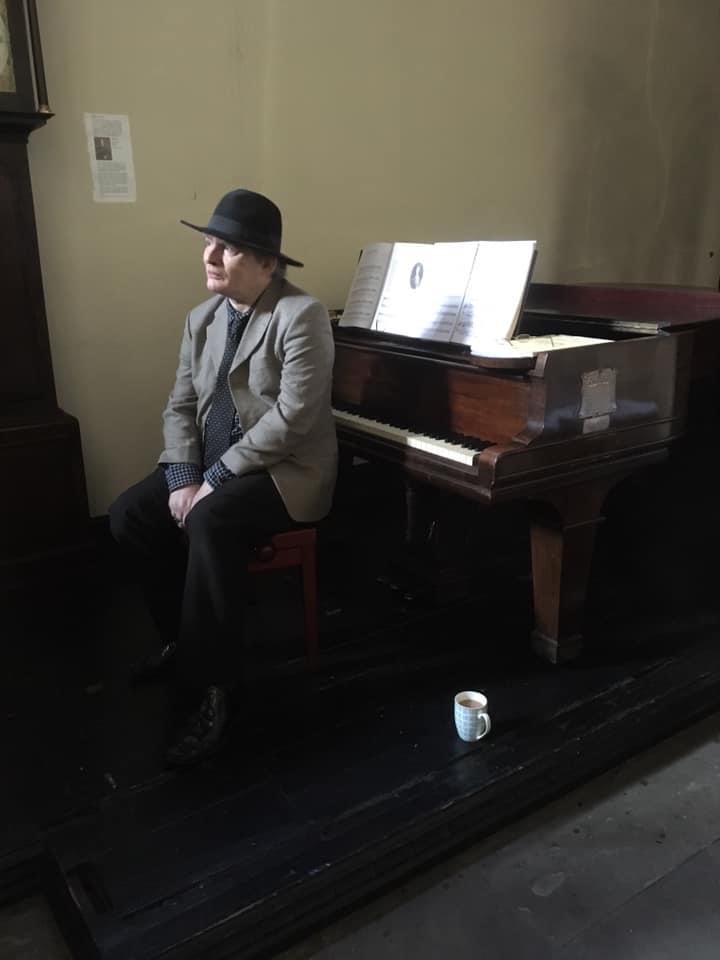
I am experienced and practiced in end of life care and I know more about depression than I really want to know, and that is why I feel capable of saying about Michael that his life was a success and his death is a tragedy – for us; because he had so much more to give and we naturally feel robbed of the warm, talented gentle and gracious person we have lost. It is a tragedy for us, not for Michael. He had taken on a capacity for engagement and was delivering the fulfilment of an artistic gift that is in my experience hardly ever rivalled. In services to fifteen or twenty people in a draughty church he offered forays into musicality and verve that performers in stadiums and arena almost never get to share; he was happy and beloved and it shone from him – the last Sunday I shared with Michael here he took requests as to the notes he should play in his improvisation and delivered as always an impeccably judged tour de force. And then on Wednesday I ‘d suggested that he play over some haiku that I read, an idea that he was initially doubtful of – but afterwards he approached me and said with his customary frankness: “that was the best I have ever played!”
In Tom Stoppard’s trilogy of plays The Coast of Utopia the central character Alexander Herzen, loses his son in a disaster at sea, little Kolya is drowned and in one scene another character sympathises that the poor boys life was cut short, but Herzen, the bereaved father, says ‘No… his life was what it was… because children grow up we think a child’s purpose is to grow up but no, a child’s purpose is to be a child… We don’t value the lily less for not being made of flint… Life’s bounty is in its flow, later is too late… where is the song when its been sung, the dance when its been danced?… Was the child happy while he lived? that is a proper question, the only question…
Iain McGilchrist describes the value of the left brain way of apprehending the world in these terms; that the goal of this hemisphere is precisely to grasp; to grasp the situation, to grapple with a problem to pin it down and get a grip. And while this is an immensely important task for cognition – we need to orient ourselves extremely efficiently and quickly – it is also a weakness of our goal orientation; because the same faculty that seeks to find a grip is also likely to prize, to hold onto and refuse to accept that there is also a beauty to letting go; that part of the completeness of life is its precariousness, it is precious because it is not forever and we don’t help ourselves by treating life as a prize to be grasped, a result we must at all costs maintain. Value it highly while we have it, as we must, we must also hold it lightly. If we grip too tightly we strangulate, and it is only in learning the gentle art of letting go that we will we find our authentic humanity, our innate generosity, and acceptance of who we are and where we dwell.
‘Where is the song when it has been sung? the dance when it has been danced?’ The reality of music doesn’t lie in the score, nor the piano, not in the reputation of the composer or the name of the piece but in the suddenness of how, when musicians play it, the music itself changes everything, in the moment while it is heard the music transcends the composer, the score, the players and becomes life itself, the sound flares, we listen to it play and when it is over …
https://www.youtube.com/watch?v=cWpVL4VMXaw&t=35s

 A Space of possibility
Leave a comment