One of the most significant scriptural biblical concepts and one of the most influential ideas around which so much of Western civilization has chosen to base itself, is the story of the fall … it is significant I think that this concept, the idea of humanity’s fall away from the grace of God, is unique to Christian tradition, the story of Adam and Eve’s expulsion from Eden is not referred to as such within Judaism, it is apparent in Islam but this may be a reflection of the huge influence of Christian theology around the time of the foundation of Islam, and as far as I know there is no sense of it in Oriental or Animist traditions…
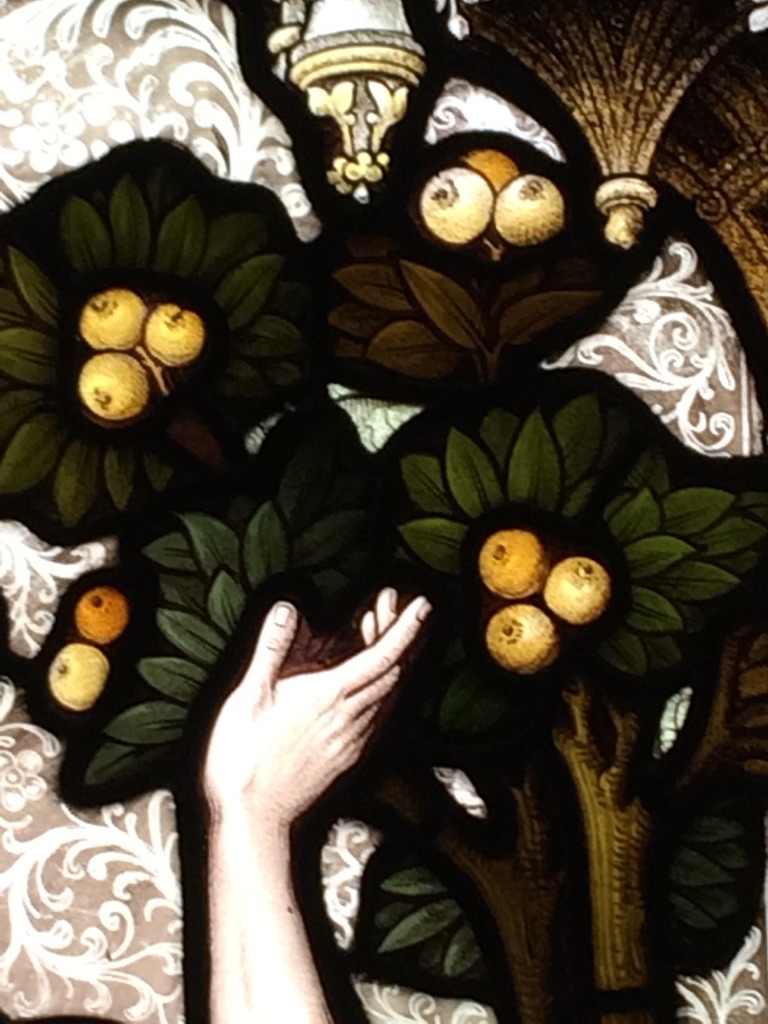
We call any age of innocence of idealistic state of blissful harmony pre-lapsarian, a rather lovely word I had to look up when I first came across it, pre-lapsarian; prior to the lapse, before the fall, a time of Eden like simplicity, as when the first man Adam dwelt in the garden with the first woman Eve.
Language in the great cycle of scriptural creation is elemental; words are the things they signify, and to speak a word is to create, as much as to name the thing, God says ‘light’ and there is light, and so on. In the verse of God’s creation of Man there is a beautiful sense of curiosity and reward – as if God is childlike and his creation begins to engage and enlarge God’s sensitivity:
In Genesis 1 we read:
31And God saw everything that he had made, and behold, it was very good. And there was evening and there was morning, a sixth day.
But in Chapter 2, vs 4 https://www.revisedenglishversion.com/Gen/2 there is what appears to be a bit of a cut and paste going on,
when God creates the first man God discovers that what he’s made is not sufficient to itself, and so God decides to adjust …
God’s creation then seems to enlarge God, God seems from this early point not be complete but subject to change …
Also of note; the first human shares some of the same attributes as God; the things he says are – as he names the animals, they become themselves.
Let us not wonder what language he spoke, languages, we know, evolve by being spoken in a huge and networked community-wide development, but here in Genesis the ‘word’ and the ‘thing’ are identical; call it an ox and lo! It is Ox. Call it a horse and hey! it is Horse.
(We may note that contemporary people are rather frustrated at the present time that they do not have this power, and that things have a stubborn tendency to be themselves whatever we call them, but that is quite another subject …)
I digress… and we all know how this particular story plays out, so I ‘m not going to go more deeply at this moment into the scripture (although I may loop back to it as we go on, because I want to consider the significance of the idea from some different perspectives) …
Is it possible that the idea of the fall is a necessary step in the narrative of salvation and redemption?
And if so, is it also possible that the development of the narrative includes the idea of people who are working things out naturally, albeit gradually, people who are working their way back towards the state of union with God … This notion of natural progress is one that also props up a distorted idea of evolution: the idea that humanity evolves out from a state of ‘natural’ superstition towards cultured rationalism is basic to our worldview. But it is also complete nonsense. People co-exist in the world at the same time and there is no evidence of any biological ‘evolution’ of thought; indigenous worldviews are independent of and equally complex as, say, post-enlightenment rational materialism …
Is this notion of fall then an idea which is politically convenient for a people who keep discovering (and exploiting) other ways of being, forcing cultures that seem to view life differently to adopt the same way of being that we have adopted? Is the story of The Fall one step on the road to Manifest Destiny?
This time of year an unmistakable shift is in the air, a change in the rhythm of the world, and in our hearts we feel it.
Let’s return to this simpler human reality then, a felt sense that something has changed, a time of warmth and brightness is passing, we see it every year, the world turns, but does not turn away…
Softly the civilised centuries fall
Paper on paper Peter on Paul (writes Alun Lewis)
The dictionary definition of fall yields up some interesting possibilities,
First we discover the unintentional, but immediately we also discover effortlessness, as when I said that prayer is something we fall to.
Listen to the unintentional ‘poetry concret’ of derivations in the Dictionary:
They fall in together, her eyes fell to the paper, His face fell, they fall in love, to fall pregnant, the city falls, the fall of troy, nuclear fall out …
it is as if the word tells its own story, as if language could still be Edenic, Adamic, a word that calls its own meanings into being…
Before I can let the story go I’ll remind you of course that this is a vast subject, probably beyond the scope of any ministry let alone a single service, and I’ll return to it, but there is something in the story we should understand and it is intention, a humane quality of desire, the thing chosen, despite our best interest, is chosen because it is desired and that is important too, ‘where the spirit of the Lord is there is freedom’ https://www.revisedenglishversion.com/2Cor/3/nav3 St Paul tells us and if this is true, freedom must be freedom to, not just freedom from, to believe a snake, to take a bite, to invent fashion; from fig leaves to haute couture, to enter the race of life and death, to fall in love …
https://poets.org/poem/i-sing-what-you-loved
Life of my life, what you loved, I sing.
If you’re near, if you’re listening,
remembering earth, in the evening,
my life, my shadow, hear me sing.
Life of my life, I can’t be still.
What is a story we never tell?
How can you find me unless I call?
Life of my life, I haven’t changed,
not turned aside and not estranged.
Come to me as the shadows grow long,
come, life of my life, if you know the song
you used to know, if you know my name.
I and the song are still the same.
Beyond time or place I keep the faith.
Follow a path or follow no path,
don’t fear the night or the rainy wind.
call me to come to you, now at the end,
and come to me, soul of my soul, my friend.
Gabriela Mistral tr. Ursula K. Le Guin
this picture is by LensLab


Leave a comment