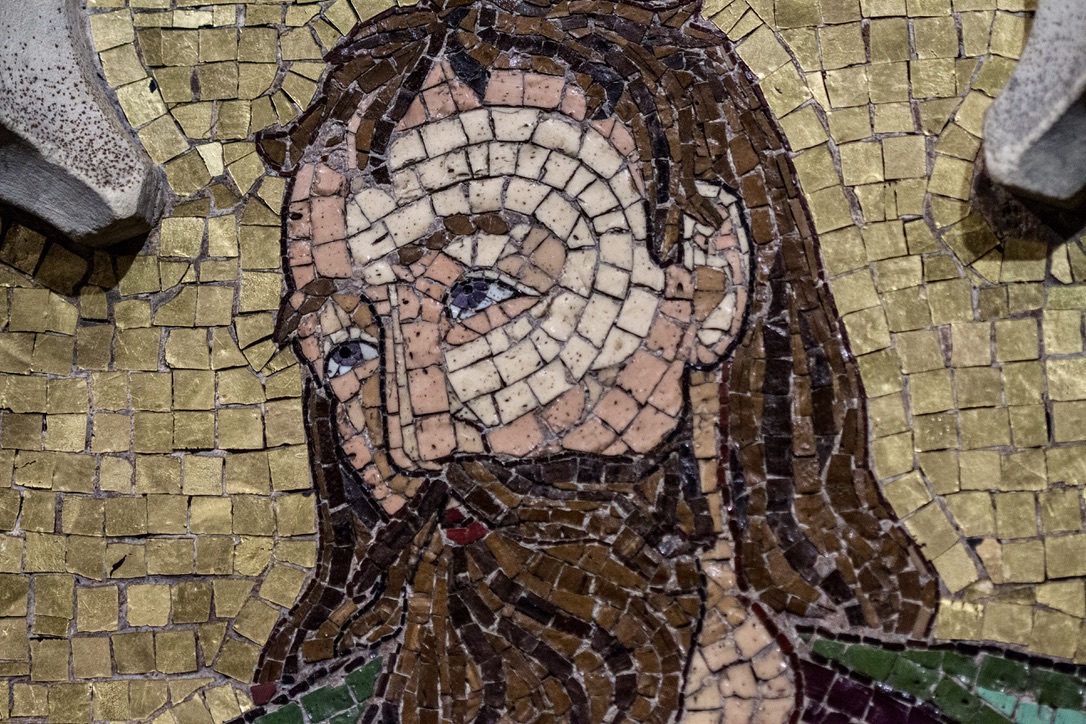
The prophets who stand on the reredos behind me are curious religious icons: it’s not just that, as John Barton points out in his marvellous History of the Bible, they were neither Priests nor teachers, it seems to me that the awe inspiring writings of Isaiah, Jeremiah, Ezkiel very rarely coincide with the format or liturgy of either Judaism or Christianity: you have to choose from their prophesies very selectively indeed to ‘domesticate’ them, as Christianity has done.
The words we quote this morning:
“…and they shall beat their swords into ploughshares, and spears into pruning hooks;
nation shall not lift up sword against nation; neither shall they learn war anymore.”
(Isaiah 2:4)
Are part of a prophesy of the restoration of peace and prosperity to God’s people, but that delightful scene is far from the majority of Isaiah’s vision I’m afraid.
Mostly Isaiah writes about the corruptions of his own age and context, and his verdict on the religion and the Kings who professed it is pretty harsh.
Perhaps that’s why Isaiah claimed the protected privilege of speaking directly from God.
Isaiah has a vision of a burning coal being placed on his lips. This metaphor has become so familiar to us that it has become mundane. But consider it again: in a society so brutal that a red hot coal could really be placed on a human’s lips the most natural reaction would be to spit it out – and I think that’s what Isaiah was saying: I can’t resist this urge to spit out my truth, even at the danger to my life that such truth might entail.
It is such urgent truth telling that Jesus wished to be associated with when he quotes Isaiah at the start of his ministry. In the Gospel of Luke Jesus goes to the synagogue in his home town, and reads aloud from the scrolls:
“The spirit of God is upon me …”
Wait, what do I mean?
It would be better to say, to admit perhaps, that the writer of Luke wished to associate Jesus with Isaiah.
That writer invented a scene where Jesus goes to a synagogue in his home town of Nazareth and reads from the scrolls. Invented, because now we have developed the archeological record of Israel/Palestine we know that Nazareth had no synagogue in the first century, but nevertheless there it is, in Luke, Jesus fetches down the scroll of the Prophets and reads from Isaiah:
The spirit of God is upon me…
It is important to understand that Isaiah, and any of the major prophets of Judaism, regardless who’s quoting who, are strident critical voices, not at all supportive of the status quo at the time that the prophetic writings were being assembled.
And yet these writings still found their way into the cannon.
It is a signal strength of the Jewish faith that it contains some extraordinary contradictions and can maintain criticism from within itself.
In one passage which is particularly awkward for those of us who manage and run churches God says through his prophet Isaiah:
“… Your incense is an abomination to me.
New moon and sabbath and calling of convocation —
I cannot endure solemn assemblies with iniquity.
Your new moons and your appointed festivals
my soul hates;
they have become a burden to me,
I am weary of bearing them.
…
your hands are full of blood.
…
cease to do evil,
learn to do good;
seek justice,
rescue the oppressed,
defend the orphan,
plead for the widow. Isaiah 1:13-15
The prophet Amos seems to work from the same template but he puts it to the religious authorities of his day even harder:
“I hate, I despise your religious festivals;
your assemblies are a stench to me.
Even though you bring me burnt offerings and grain offerings,
I will not accept them.
Though you bring choice fellowship offerings,
I will have no regard for them.
Away with the noise of your songs!
I will not listen to the music of your harps.
But let justice roll on like a river,
righteousness like a never-failing stream! Amos 5:21-24
These prophets become integral to the very religion they criticised because their criticism is unanswerable – and their vision of God advances, and sometimes radically changes, the theology of the Divine.
And in turn they were appropriated into Christianity too. Countless times the Gospel writers refer back to the prophets and use their words retrographically to strengthen their claims that their own prophet, Jesus, as the Messiah, the anointed one of God.
But they use quotation very selectively.
For Christian writers the main point to raise up from all the writings of the Jewish prophets is not their vision of justice, nor their criticism of religious authority, nor their sense of catastrophe, but that they foretold the coming of the Messiah, and that their own uniquely divine ‘Son of God’ must be that Messiah prophesied (amongst many hundreds of verses of prophesy, about six verses make mention of a messiah).
But once again the main thrust of the prophetic writings – that human corruption is going to lead to destructive power of unimaginable proportions and that the only way to forestall this from happening is to return to the ways of the spirit of God in the affairs of people, that message is ignored.
Such a strategic pattern of selectively quoting (and even sometimes turning the meaning of) prophetic passages reaches a new high point when, in the third century, the Roman Empire needed a religion to unite the masses, a religion which might appeal to rich and poor alike and which had accessible and understandable liturgy and stories which could unify its disparate legions. The religion which the Emperor Constantine took up was Christianity, despite its outsider and underground status.
From despising and persecuting the followers of Jesus, from throwing Christians to the lions for sport, the new leaders of the Holy Roman Empire deified and centred some religious elements of Christian theology, while largely disregarding the unacceptable or awkward parts of Jesus’ actual message.
Can you see a pattern here?
At that point Roman writers and translators needed to distance themselves from the historical account of the Roman occupation of Judea, and later Christian religious scribes also selectively quoted the Gospels to make the Roman military execution of Jesus seem to be more the responsibility of the Jewish religious authorities than the Roman occupiers.
This selective re-telling of the story, to erase Roman guilt and instead implicate the Jewish people in the crucifixion, began what is called ‘the blood libel’, the claim that the Jewish people were responsible for the execution of Jesus.
Since they also claimed that Jesus was very God, their narrative created a toxic depiction of Jewish people as ‘God killers’ which grotesquely distorted European culture. Over centuries pogroms, mass evictions and slaughters of Jews became commonplace, and in the last century, the Shoah, or Holocaust, perpetrated by the Nazis was to claim the lives of 6 million Jews in an act of industrialised murder.
When the truth claims of a religious tradition are distorted to prop up the political claims of an Imperial system, terrible outcomes can ensue.
Selective Remembrance
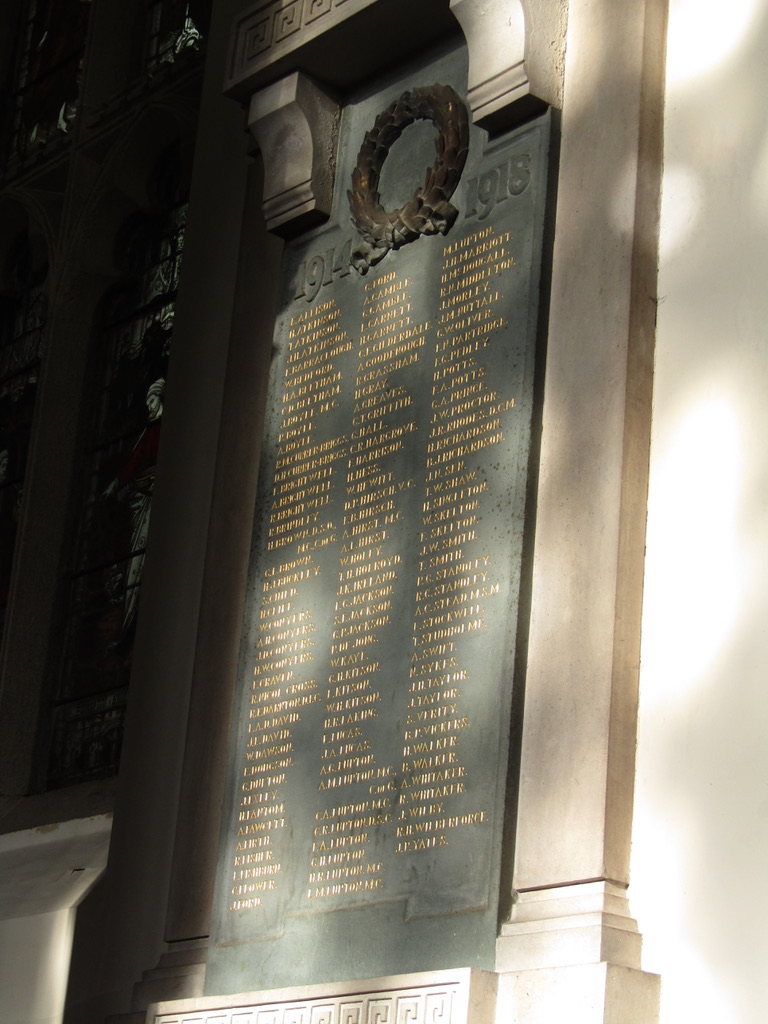
Every year we remember them – at the going down of the sun and in the morning – we remember a whole generation betrayed by a corrupt system, an army of conscripts squandered in blood by aristocratic Generals.
The wholesale slaughter of the 1914-18 war was shockingly brutal, as the new industrial system of belt driven machines and technologies of scale collided with the old fashioned battlefield chivalry of European warcraft. Where once archers and swordsmen would have wheeled about in a single field, now city-cide scale metropolitan butchery took place across whole regions, countries. The scientist and industrialist conspired together in the slaughter of the trenches and the outcome was grandiose bloodshed. Biblical tragedy.
And in order to negotiate the cultural fall out of this tragedy, to negotiate such loss of life without suffering revolution as Russia did, in order to maintain and sustain the dominance of Empire and class, Christian Churches transformed the anti-Imperial message of peace and love actually preached by Jesus into a narrative of blood redemption and self-sacrifice for King and country.
In churches and town squares up and down England today Bishops and Vicars have begun their services with these words from the Gospel of St John:
“Greater love has no man than this: that a man lays down his life for his friends.”
But as with the selective quotation of the Prophets, this is also to utterly mis-appropriate both the meaning and spirit of John’s verse – which is to make the self-giving of Jesus a proof of his deity.

This year is the 100 years anniversary of the laying of this floor – beautiful Italian marble – to commemorate and give thanks for victory. The bereaved women of the Mill Hill congregation, The Women’s League, fund-raised and oversaw its installation. Actually, little history lesson:
In 1921 Leeds city corporation decided to erect a Victory memorial, a huge winged victory statue with a gracious surround. The monument now stands outside the museum, but in ’21 it was erected right outside Mill Hill Chapel on City Square. But representatives from this church were prevented from participating, they were not invited to the dedication ceremony. Even though all these Mill Hill members (remembered inside on the wall plaque) went to France, and even though many of them died – and some of them were awarded the highest honours; the Victoria Cross and Military Cross and so on, and even though its then minister Nicol Cross was himself a survivor and made history as the first clergy to join up not as a chaplain but as a member of the Army (he served both in Palestine and France), the City authorities decided deny representatives of Mill Hill the right to participate in the memorial.
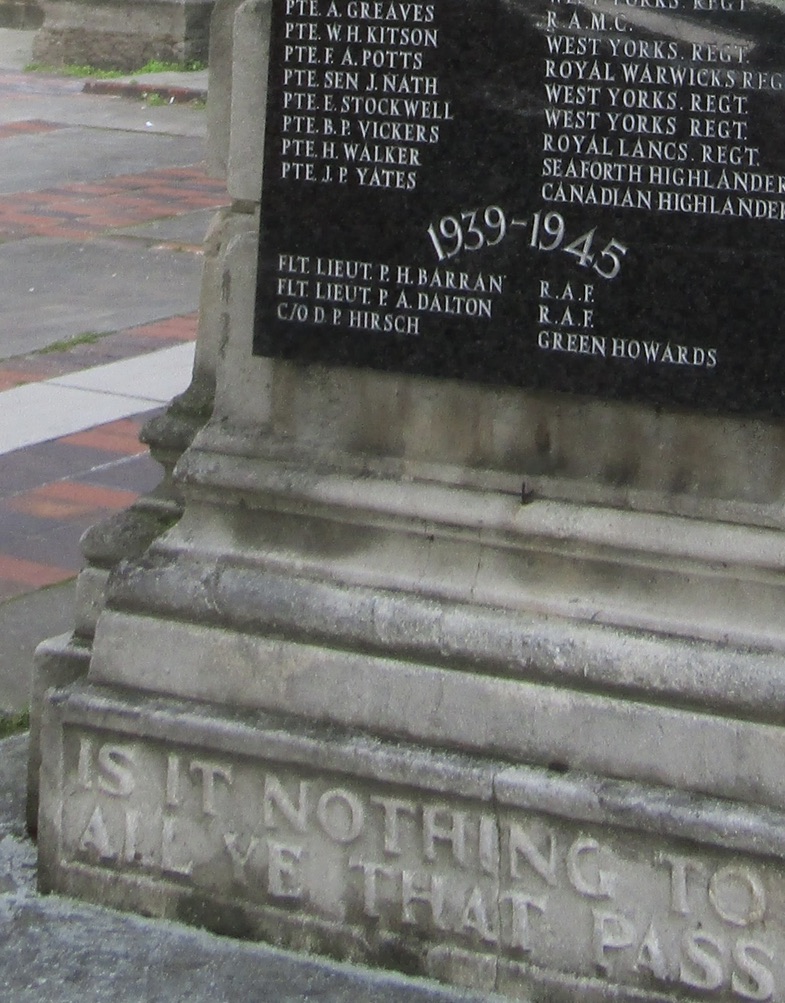
That’s why we took the unusual step of erecting our own memorial in the yard with its quotation from the book of Lamentations: “Is it nothing to you who pass by?”.
So even in the memorial of the war so soon after it, even in 1921 there was very little evidence of those Christian virtues we now make so much of : solidarity in grief, the value of community, the human family united in sacrifice.
Perhaps it was just never really part of the project.
Throughout the services of these centenary years 2014-2018 I have dutifully fulfilled the cultural requirement for a properly maintained ceremonial. We have heard the familiar words and sung the required songs, but I mean to set this burden down henceforward, as I can no longer believe that religion should serve to support government, affirm Empire – or any earthly power – or justify war.
Without intending any disrespect to anyone serving in the army, or any relative, and without diminishing the self-sacrifice of any individual, or any family, I just don’t believe that the British Army deserve this national celebration.
I don’t believe in the poppy, I don’t even think much of the white one, but the red one, dedicated as it is for British casualties and British dead is, in my opinion, a travesty, a fake and a sordid sham.
Our politicians and indeed all celebrities wear the poppy with a religious fervour on every tv channel for weeks before today.
But how do we in deed honour our glorious dead?
According to a recent report in the Independent newspaper: The UK government has paid compensation of less than £1000.00 per child for fatalities involving children killed by the British military in Afganistan.
“In total, some 164 people were killed in those attacks involving confirmed or suspected children,” the report said. According to the records, the youngest casualty was a one-year-old child and the oldest was 15, with the average age being six.
“Most of these deaths happened during crossfires and airstrikes raising questions about the military not properly adhering to rules of engagement.”
Is anyone thinking of the ancient witness of the prophets as they stand in empty silence at cenotaphs as the rain falls this morning?
“…And when ye spread forth your hands, I will hide mine eyes from you: yea, when ye make many prayers, I will not hear: your hands are full of blood…”
When they speak of sacrifice will they consider these words of Jesus in the same passage of St John:
These things I command you – that ye love one another … and ye also shall bear witness …
It is my proposal to lay down this annual service of Remembrance here today, to lay it down and as a liberal Christian community aware of the whole history of our tradition, I propose that we henceforward remember instead the Holocaust on the nearest Sunday to Holocaust Memorial Day, which next year will fall on January 29th.
 A Space of possibility
Leave a comment