When a population becomes distracted by trivia, when cultural life is redefined as a perpetual round of entertainments, when serious public conversation becomes a form of baby-talk, when, in short, a people become an audience, and their public business a vaudeville act, then a nation finds itself at risk; culture-death is a clear possibility. ~
Neil Postman from Amusing Ourselves to Death
Some of you will remember an incident a couple of weeks ago when a troubled young man (lets call him Bob) came in, and I felt forced to escort him back out again. Bob comes here quite often and I like him. He suffers from a combination of issues arising from his atypical neurological condition and his tendency to over rely on self-medicating with drink and drugs. He often spills his drink and/or drops his belongings or even slides right to the floor, but on this occasion he was right out of it and noisily interrupted in the quietest part of the service and I had to make a really difficult calculation – how many people’s experience of prayer can be disrupted for the sake of one person?
As kindly as I could I asked him to leave.
But its been on my mind since, and I shared the story with a friend (lets call him Billy) who also suffers from many of the same social and mental health problems as Bob. Billy is autistic and he described the sense of shock that a person like him feels, having come from the brightness outside where his defenses are all way up on full, into this enclosed but vast and decorative space where people are sitting quietly and the light and acoustic quality are so different. Billy explained that Bob could have experienced a disorienting psychological shock that he couldn’t handle …
Well, I believe this kind of ‘psychological shock’ is a universal experience; all of us experience a transitional sense of dislocation or shock on coming into participation with such a space as this, even if we have different ways of dealing with it…
If you’re sometimes late and arrive in a rush in the middle of a service you’ll already know this on some level.
Perhaps you’ve noticed how often I allude to the threshold: of how important courage is at any threshold, how the journey across the threshold between the head and heart is the most important and also the most difficult…
It occurred to me that a service of worship is carefully and intentionally constructed to facilitate psychological transition gently.
To navigate the psychological territory well is a deliberate element of a service of worship.
These intentional liturgical building blocks, the way that a service is structured, can be more or less obvious according to the style of the worship leader, but in a good service they will always be there.
I believe that our approach to the Divine is participatory – we hold a space here for a direct personal experience of the sacred – but the fact that each of us is personally responsible for what we believe and how we feel about that experience makes our process very important, because without doctrines which de-limit or proscribe the nature of our experience it is important we are able to hold some quite different feelings and experiences in community together…
Its important to notice that I am not trying to make specific or particular truth claims about God or beliefs at this point, I am talking about the way we approach the sacred …
When I was thinking about trying to say what I mean, I realised I could do it better through a quite specific example so I thought I’d ask for your help with this: I want to ask for your help in remembering something together which is commonly shared by all of us: so let me ask you to collaborate as we put together from memory a service which we are all familiar with, whether we think of ourselves as church goers or not: a wedding. I know some of you will have been to a wedding recently, I have conducted dozens weddings so I know how they work and I just want to ask you about the story of a wedding: it doesn’t have to be your own but it could be, and I want you to start right at the very beginning what happens first?
… Well first of all is the preparation and this can begin weeks or even months ahead, perhaps buying clothes, booking train tickets, then on the day an early start, making a journey to an unfamiliar place, then arriving at last and spotting friends in the distance along with family outside the church and as we draw nearer and begin to greet one another, small talk and body language communicate the recognition of social networks and our position within them…
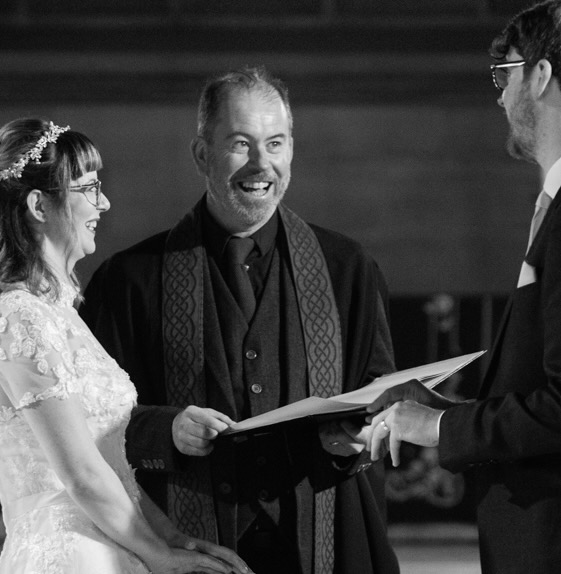
But no matter how special or fancy a wedding is an example of a service of worship it follows the same pattern and when you get to know it it works in exactly the same as any other service: it is carefully designed to allow us to make a transition from the ordinary and mundane into proximity with the sacred and holy.
It doesn’t matter how you define sacred by the way, whenever you make this journey towards the sacred you instinctively ‘genuflect’, you physically express awe, the impact of awe on the body. Think of a moment when someone draws your attention to something sacred: look at this baby’s finger print, smell this honeysuckle, reverence has a way of being which we know instinctively but which our culture is in danger of distracting us from because it has no use for it… Our culture simply doesn’t know what to do with reverence and that is why we are largely ignored; that’s why church provokes the antagonism and hostility it does… I ve noticed recently that people are beginning to forget their way around a wedding because the wedding, once part of church going, is dislocated from it … left in the lurch … did you know by the way, that the waiting area that is sometimes attached to the church lych gate is called the lurch, and if a bride didn’t show up her groom was left ‘in the lurch’
There are many very famous examples in films of exactly what I ‘m talking about, think of Four Weddings and a Funeral which begins with its protagonist waking up late and rushing to the service where he of course crashes the temperature and encounters a psychological shock for which he is completely unprepared…
Another even more famous example is The Godfather which begins with a wedding, the Catholic Francis Ford Coppola would know very well that a wedding precedes a christening, and it is at the christening that the protagonist becomes the Godfather… In the famous scene where Michael, played by Al Pacino, settles all his family debts, he is in Church and the Latin liturgical sing-song “Do you renounce the devil and his works?” – “I do” is shockingly juxtaposed with the most savage and bloody butchery that exposes, precisely, the difference between the sacred and the profane. The film maker exploiting exactly the same profound psychological shock I’ve been describing…
The ‘lurch’, the Church vestibule, is a place of transition (that is what the word profane really comes from we take it to mean the opposite of reverence – but it really comes from the room ‘before the sacred’ the pro – fane)
I’m trying to draw your attention to this, I’m trying to bring it into consciousness not because I want to preserve the theatre or drama of it but the very opposite of that, because I want you to know what is available to authentically experience within it and why … because if we are to be able to preserve the authenticity of this experience we must always be renewing and revising, always consciously adjusting our selves, always returning, like a flame that is always becoming – and that is our uniqueness; our way of faith is not to profess a belief an creed or an ultimate answer but to experience together a way of moving towards it, a means of approach…
“Where should one learn about the insights of the spirit?” Asks Rabbi Abraham Heschel in his wonderful essay ‘The Vocation of the Cantor’ “…where are the occasions for inner silence?… Who will teach us how to be still?… It is surely important to develop a sense of humor, but is it not also important to develop a sense of reverence? We must learn to be sensitive to the spirit. One needs an atmosphere, where the concern for the spirit is shared by a community … we need the company of witnesses, of human beings who are engaged in worship, who for a moment sense the truth that life is meaningless without attachment to God…”
I ve been using the example of a wedding, but I could just as easily have been talking about a funeral. It operates the same levers of re-connection and reverence. In a wedding we vow to endure the greatest pressure our lives can put us through; we promise to be with someone who will, for sure, operate all our personal levers, we covenant our worship exclusively to another and no less. In a funeral we collectively acknowledge another kind of threshold, a transition that we understand even less well. These momentous transitions are dislocated when they come out of proximity with places of reverence. Places like church, which we seem to understand so little now …
This summer I put forward the suggestion that I might conduct our weekday contemplative service in the open-air art installation outside on City Square, but the team of curators described this in their promotional material as: ‘Wednesday Wellness’. They wanted to situate the service within a framing they can deal with, as if proximity to something awesome was only therapy. In doing so they revealed how little they understand the purpose of art – as well as the purpose of religion … I believe that, far from providing comfort, connection to God can and should provoke awe, disturbance, a psychological pressure that there is no way out of; the only way out is through. While we walk through this disturbance together, the way we walk becomes of first importance, the way we hold one another through the great transitions of life in connection with another…
superstition, like belief, must die,
And what remains when disbelief has gone …
A purpose more obscure.
Philip Larkin’s words are the words I’ll close with becasue it is poetry not theology which can contain the deepest truth, as Jesus knew when (Luke 4:17) he called on the prophet Isaiah to begin his ministry on that Sabbath day…
“A serious house on serious earth it is,
In whose blent air all our compulsions meet,
Are recognised, and robed as destinies.
And that much never can be obsolete,
Since someone will forever be surprising
A hunger in himself to be more serious,
And gravitating with it to this ground,
Which, he once heard, was proper to grow wise in,
If only that so many dead lie round.
Blessing
Whatsoever things are true, whatsoever things are honest, whatsoever things are just, whatsoever things are pure, whatsoever things are lovely, whatsoever things are of good report; if there be any virtue, and if there be any praise, think on these things. Paul – Letter to the church at Phillipi 4:8
 A Space of possibility
Leave a comment